

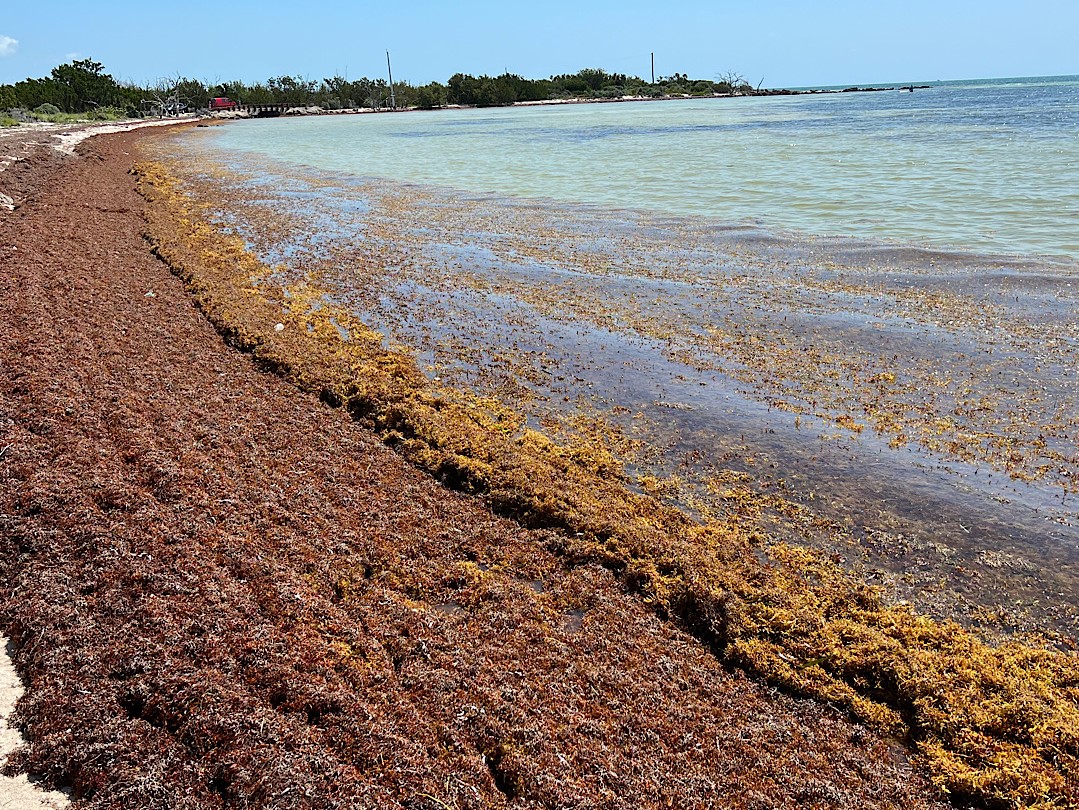
Scientists are trying to identify the reasons behind the phenomenon of seaweed buildup periodically blanketing Galveston beaches and other locales along the Texas coast, which has turned into a semi-annual event.
Peter Morton, an associate research scientist with the Texas A&M Department of Oceanography, said sargassum — a specific type of seaweed — has long been native to the Atlantic Ocean, but has only recently begun to grow exponentially.
"Sargassum has always grown in the Sargasso Sea. We have records going back to Christopher Columbus' voyage," Morton said. "What's new is this Great Atlantic Sargassum Belt that first appeared in 2011."
What is unique about the Great Atlantic Sargassum Belt is that it formed outside of the Sargasso Sea — which is located in the Atlantic Ocean off the coast of North America. Morton said the sargassum belt has extended far outside of the Sargasso Sea's traditional boundaries, stretching in some cases all the way to the coast of Africa.
The natural currents of the Atlantic Ocean cause this great mass of seaweed to periodically drift from Africa to South America and eventually to North America, where it is deposited on beaches along the Texas and Florida coastlines, Morton said.
"It's actually starting to grow off the coast of Africa and around January or February is when it kind of really starts to take off," he said. "That sargassum is then carried by ocean currents across the Atlantic to the coast of South America. ... It continues to grow and is again transported to the Caribbean and the Gulf to be deposited on the Yucatan Peninsula and all along the Texas coastline."
Morton's area of expertise deals with the nutritional composition of sargassum, which he said has been changing over the past several decades. While sargassum typically needs nitrogen and phosphorus to survive, Morton said it has recently begun to substitute its need for phosphorus with other compounds such as arsenic.
"So when the sargassum is phosphorus-starved, it compromises quality for quantity and takes up other elements that have chemistries similar to that of phosphorus, the most important one being arsenic," he said. "It ends up becoming incredibly enriched in arsenic, maybe a million times greater than what you would find in the seawater where it grows."
While Morton said the sargassum that washes up on shore is not dangerous to the beach-going public, he and other researchers are trying to piece together what's causing this change in nutrients and how it may be contributing to the seaweed’s exponential growth over the past 14 years.
"It kind of smells bad, but here in Texas, there's no immediate risk of exposure," he said. "It is a natural thing that happens. At certain times, in certain areas, it becomes so intense that it becomes a potential threat."
As for sargassum's impact on the Atlantic ecosystem, Morton said it can have both positive and negative effects.
"It does provide a habitat. It is like an ocean forest. Little fish, crabs, sea turtles and so many organisms kind of use that as their habitat out in the ocean," he said. "But, like you can imagine, if this material washes up in such masses that if there's a sea turtle nest and it kind of buries that nest, that impedes the freshly hatched sea turtles from reaching the ocean."
Morton said researchers have not yet been able to confidently identify what is causing the influx of sargassum in the Atlantic, but that some of the leading theories place the partial blame on human-made pollutants that have made their way into the ocean.
"Right now, we can't say for sure what it is that's driving the Great Atlantic Sargassum Belt," he said. "But we are looking into nutritional values of what's coming from rivers, and what's coming from different sorts of aerosols that are blowing from the continent into the remote ocean, including industrial pollution, biomass [rain forest] burning and Saharan dust."
Copyright 2025 Houston Public Media News 88.7